VSI at Languages & The Media 2026

VSI joined the localisation community at Languages & The Media 2026 at Senate House, London, on 5-6 of November. Broadcasters, streamers, games publishers, researchers and language service providers came together around one big question: how can technology help content travel further without losing what makes it connect with audiences? 

Two members of our team took part in panels. Esther Calatayud, COO, spoke on the opening panel, and Dimitri Konovalov, Global Director of Technology and Innovation, joined a session on AI dubbing. Here is what they shared, and what we took away from the conference as a whole. 
L_M.jpg

Opening Panel: Global Reach or Global Resonance? The Role of Localisation in Moving Audiences 

The opening panel set the tone for the conference. It asked how our industry can use technology to extend the reach of content without losing the creative, linguistic, and cultural qualities that make it resonate. 
 
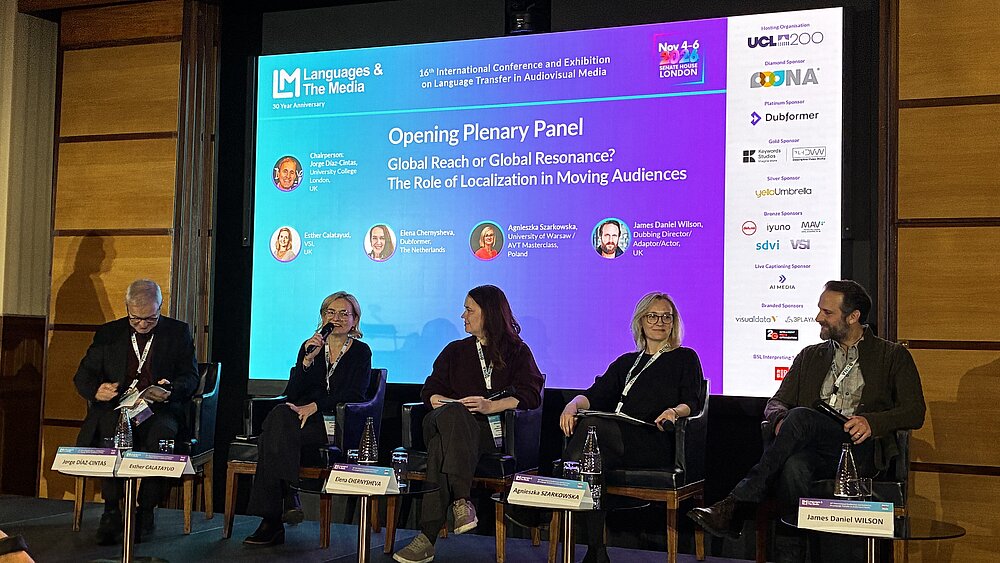
Chaired by Jorge Díaz-Cintas of University College London, the panel brought Esther together with Elena Chernysheva of Dubformer, Agnieszka Szarkowska of the University of Warsaw and AVT Masterclass, and dubbing director, adaptor and actor James Daniel Wilson.

Esther_-_L_M_Panel.jpg

Esther highlighted three themes from the discussion: 

  • Creative performance still matters. Carrying a character's personality, emotion and intent into another language is a craft. Technology can support it, but actors and directors remain fundamental, especially for premium and emotionally complex content. 

  • Linguists bring more than a final check. Their judgement, cultural understanding and creative problem-solving should shape the work, not just review machine output. The industry needs to keep developing the next generation of specialists and nurture the talent for the years to come. 

  • AI can open up new audiences. Some content stays unlocalised because traditional production is not commercially viable. Used well, AI-assisted approaches can make more titles and languages possible. 

Esther's view is that no single localisation model suits every title. "Content, audience expectations, platform, budget and commercial opportunities all matter," she said. That is why VSI looks at the whole workflow through to final delivery, rather than assuming automation always means savings. Human review, creative adaptation, corrections, quality control, time and cost all count towards the real value of an approach. 

"Our role is to help clients make those choices with confidence," Esther explained. That means knowing where investment in talent and production makes the biggest difference, and where technology can improve speed or cost while keeping the agreed quality. Done well, those efficiencies can make extra titles, languages and markets viable. 

From Acceptable to Convincing? AI Dubbing, Human Creativity and Industry Change  

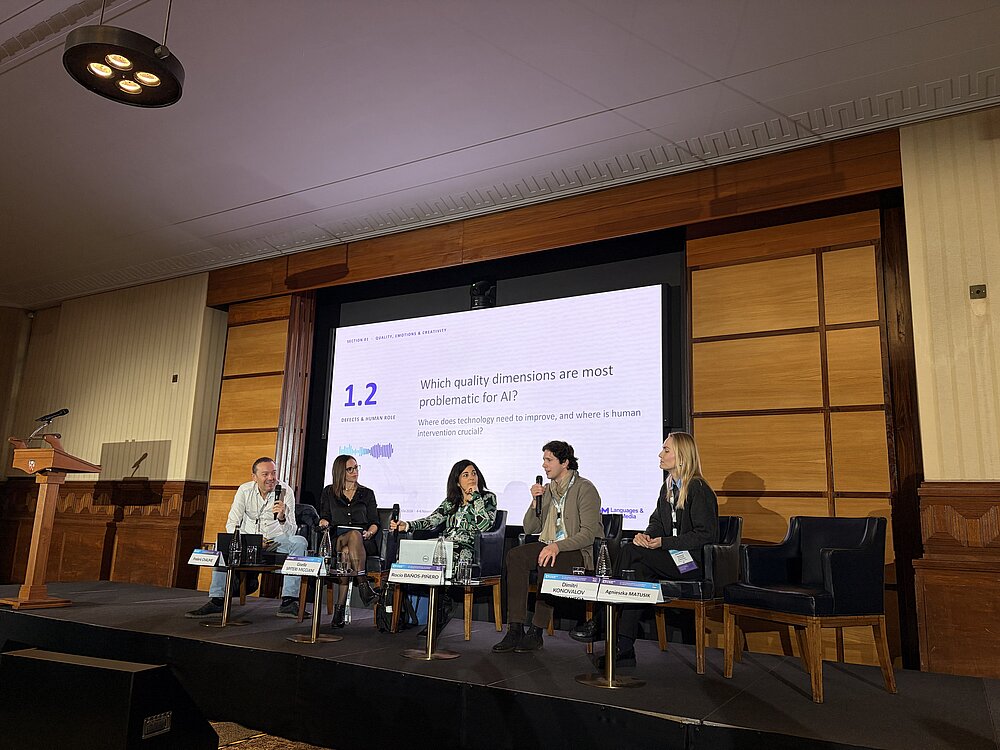
Chaired by Frederic Chaume of University College London and University Jaume I, this panel brought Dimitri together with Rocío Baños-Piñero of University College London, Giselle Spiteri-Miggiani of the University of Malta and Agnieszka Matusik of Dubformer to discuss AI dubbing, human creativity and industry change.  

The panel agreed that while AI dubbing already works commercially for some content, it still struggles to match traditional dubbing for emotional depth, performance and lip sync - particularly with sarcasm, irony and subtle shifts in tone.  

Dimitri_-_L_M_Panel.jpg

Dimitri also pointed to two areas that are often underestimated in AI dubbing: 

  • Voice casting. Quickly choosing a synthetic voice from a short sample can cause problems later in production. Voices need testing against the real demands of the content. 

  • Audio editing and mixing. These matter as much as ever, and sometimes more, because synthetic speech brings its own technical and performance limits. 

On quality evaluation, Dimitri noted that detailed scoring is most useful when introducing a new technology or workflow. Once a process is proven, the focus can move to catching critical errors and confirming the output meets the client's requirements. 

Voice rights, fair pay for performers and transparency were recurring themes. The panel explored when and how AI-generated content should be labelled for audiences, noting that while some viewers care strongly about transparency, others place less importance on it.   

Dimitri also highlighted how AI is opening new opportunities for content that was previously out of reach for traditional dubbing, and how this is changing the relationship between localisation providers and their clients. For example, content creators increasingly want support beyond localisation, from launching and managing YouTube channels to marketing activities that help them reach new audiences. He stressed that in these cases, localisation expertise alone does not guarantee success, so providers need to understand how clients distribute and commercialise their content.

Key takeaways from the conference

Across the sessions, a few clear themes emerged. 

  • Quality depends on purpose. A perfect translation can still fail if it does not connect with its audience. Riot Games showed how agreeing on a content's purpose, audience, risks and measure of success before localisation begins helps choose the right workflow. For example, in one VALORANT social video, deliberately broken English and synthetic voices recreated a popular meme format. By traditional standards, it might look like poor quality, but it was exactly what the audience found funny and engaging. 

  • One model does not fit all. Premium premieres, catalogue titles, FAST (Free Ad-Supported Streaming Television) channels and news have different needs for quality, speed and cost. Content tiering helps route each asset to the right mix of people and technology. 

  • Context comes before automation. Many machine translation errors come from missing on-screen context, such as who is speaking and to whom. Analysing content before translation can improve consistency across subtitling, dubbing and audio description. 

  • AI is creating new demand. Much of the near-term opportunity lies in content that would otherwise go untranslated, such as social video, micro dramas, factual programming and large libraries. 

  • Practical automation is already delivering. Broadcasters described real value from automated transcription, metadata, language identification, quality checks and cloud workflows that connect scheduling, media and localisation. 

  • Savings need the full picture. Several panels questioned the idea that AI automatically cuts costs. A fair comparison includes review, creative adaptation, revisions, integration and quality assurance. 

  • Localisation should be measured by outcomes. Game publishers are using player data, such as which language players actually choose, to show the commercial value of localisation. 

  • Trust and responsibility matter. Voice rights, performer pay, transparency about AI use, content provenance and environmental impact was a key part of the conversation.  

Looking ahead

We left Languages & The Media optimistic about the future of localisation. As Esther put it, challenges are also opportunities to rethink, adapt and find better ways forward. The depth of talent, expertise and passion at the event shows our industry is well placed to turn today's obstacles into practical, scalable solutions for clients and audiences. 

Thank you to the organisers, our fellow panellists and everyone who joined the conversation. 

Let's talk

To find out how VSI can help you balance creative expertise and technology for your content, get in touch.